

by Steve Sass and Amanda Smith
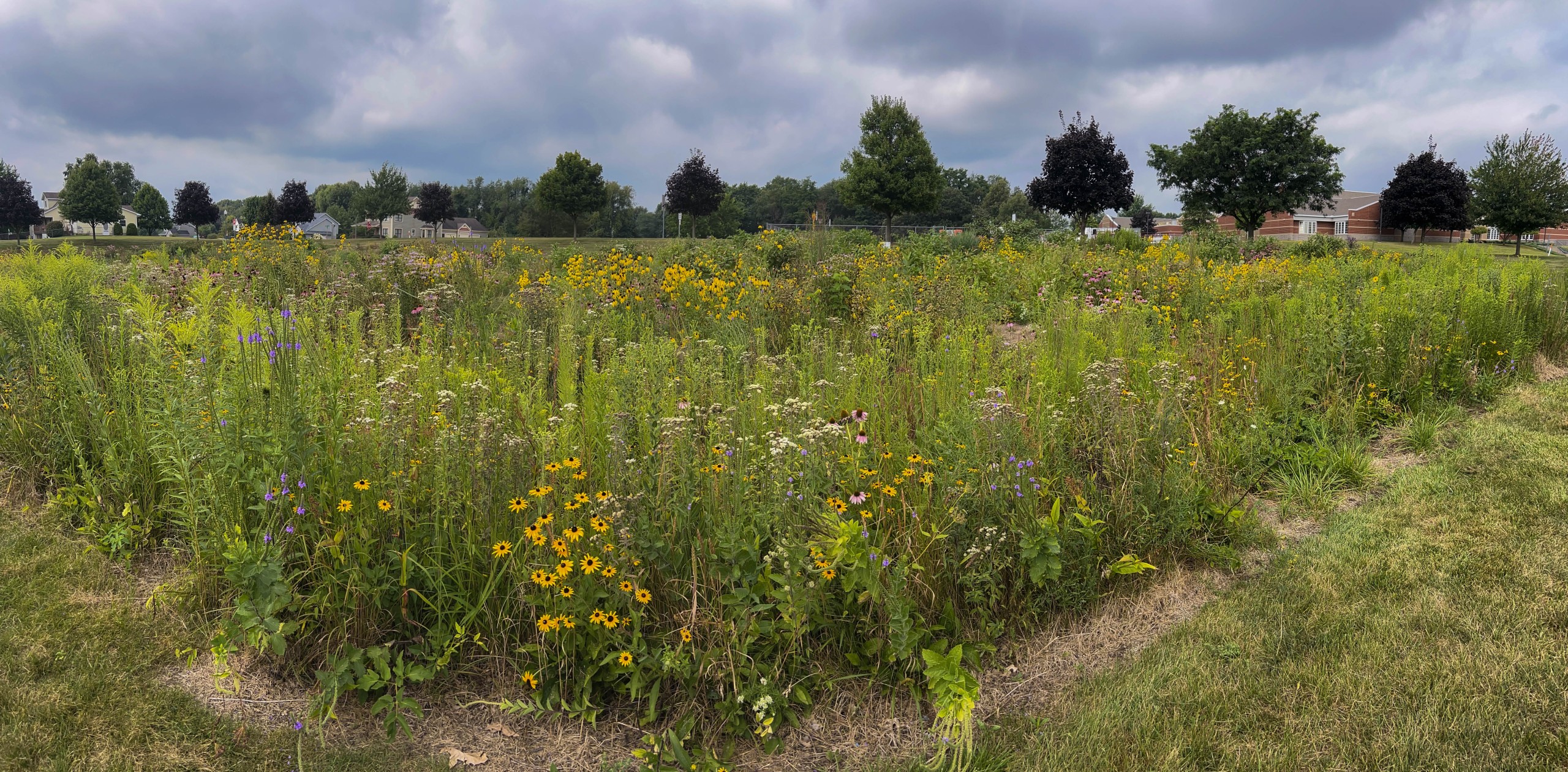
In April 2025, we detailed the history of the new Carlisle Olive Township Library’s naturalized meadow and the efforts to maintain it (https://ncpl.lib.in.us/2025/
In 2025, we began implementing a standardized method for tracking the progress of our stewardship initiatives. Utilizing GIS technology, we plotted 20 points along a grid throughout the meadow. On June 30, we visited each of those points. Utilizing a 1-meter-diameter hoop, we recorded the species and abundance of each plant within the circle. We also took photographs from each of the 20 points facing north, south, east, west, and directly above (to record any canopy coverage).
We input the data into several formulas to help assess the floristic quality of the meadow. The coefficient of conservation, or “C-value,” is a 0-10 integer assigned to each plant species to represent its degree of tolerance of degraded habitats. Plants with low C-values can withstand and even thrive in disturbed areas, whereas plants with high C-values are typically only found in high-quality, stable systems. For example, pokeweed (Phytolacca americana), an early-successional native plant (C = 0), is a common component of old fields. At the other end of the spectrum, sand coreopsis (Coreopsis lanceolata), a plant associated with stable ecosystems, has a C-value of 8. Both plants are present in the meadow.
By computing the mean C-value of each of the 20 points and analyzing the species present, we can glean insight to aid with stewardship. For instance, a mean C value of 3.2 indicates an area with ecological stability, whereas a point with a mean C value of 0 indicates a complete absence of conservative plants. These statistics help identify the areas that need the most attention.
Overall, the metrics indicate that the meadow is progressing towards ecological stability, but floristic quality varies substantially from point to point. The highest quality areas are the southern portion of the nutrient-deprived basin, where conservative plants such as little bluestem (Schizachyrium scoparium), wild lupine (Lupinus perennis), and butterfly milkweed (Asclepias tuberosa) thrive. However, along the northern slope, particularly where we performed heavy weed mitigation, exotic and early successional native plants continue to dominate.
By performing this study annually, we will track changes to the meadow and quantify the successes or failures of our management efforts. In addition to computing the Mean C-value of each of the 20 points, we have also computed other metrics such as the wetness coefficient (W-value), the Floristic Quality Index (FQI), species relative importance, and much more. You can view the full report here: https://ecometrid.com/files/