

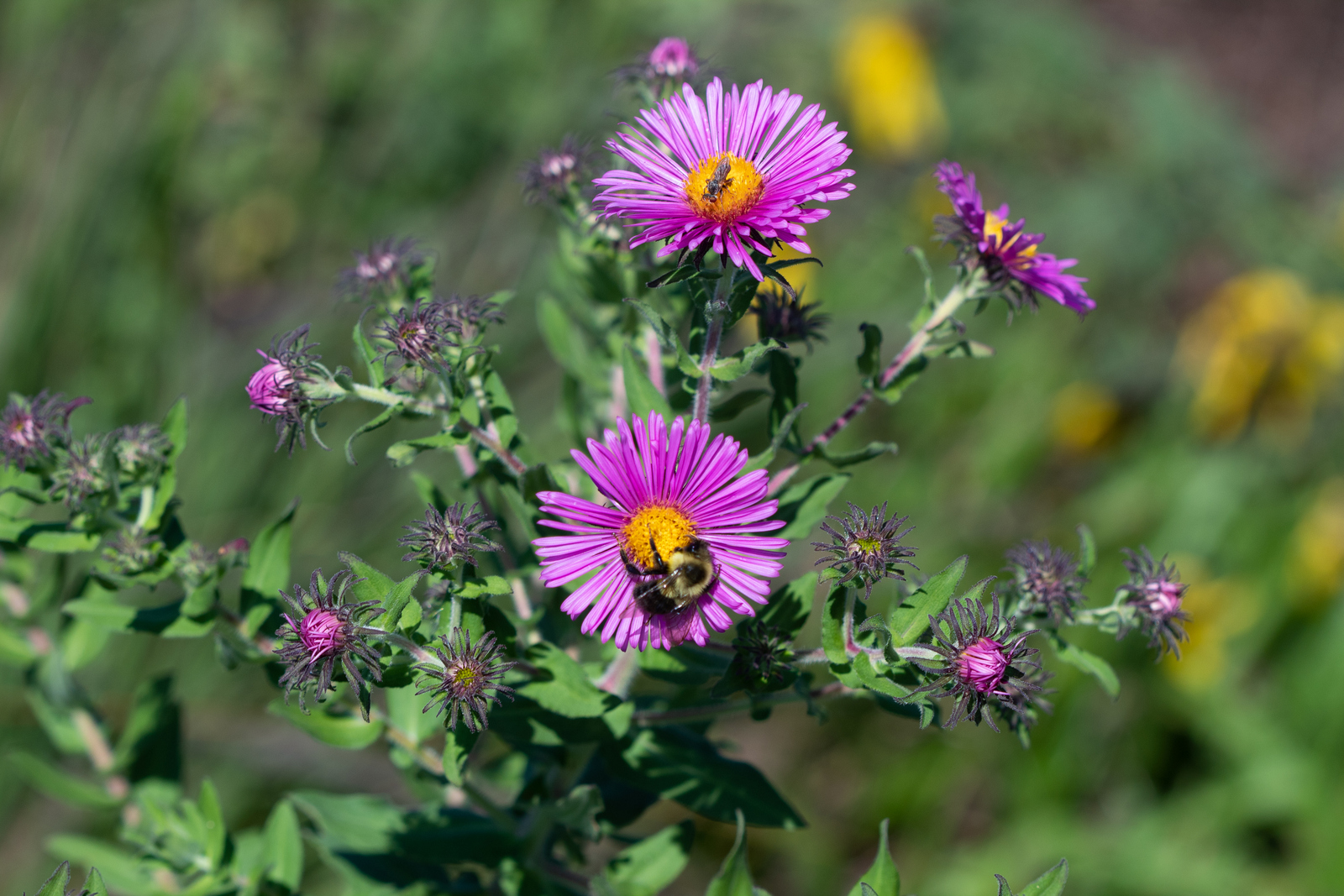
by Steve Sass and Amanda Smith
With autumn upon us and the daylight hours shortening, as tree leaves transition from green to shades of yellows, oranges, and reds, our native asters represent some of the final, vibrant gasps of nature’s floristic glory.
The word “aster” is Latin with origins borrowed from the ancient Greek word for “star,” and a closer inspection of their blooms leaves little doubt about the inspiration for their name. In Greek Mythology, Astraea, the goddess of justice and purity, left Earth due to its wickedness and took her place amongst the constellation Virgo. Saddened by Earth’s increasing injustice (or by some accounts, by the lack of stars), her tears fell to Earth, and wherever they landed grew plants that blossomed into star-like flowers. Asters are the birth flower of September, and symbolize justice, purity, wisdom, and patience.
Scientifically, asters are part of the plant family Asteraceae, also known as the aster, composite, daisy, or sunflower family. With over 32,000 members worldwide, Asteraceae is arguably the most successful and numerous plant family in the world. It’s also a relative newcomer to Earth, having evolved around 70 million years ago during the Late Cretaceous Period, shortly after the arrival of pollinating insects. Unsurprisingly, many Asteraceae rely on insects for pollination.
Superficially, individual aster blooms (called inflorescences) may resemble one flower, but closer inspection reveals that each consists of many individual flowers. Additionally, aster inflorescences contain two different types of flowers: disc flowers, located in the center of the inflorescence, whose collective presence comprises the “sun disc”, and ray flowers, which are the narrow, petal-like structures surrounding the sun discs and resembling the rays emanating from a star.
Taxonomists formerly placed many family members into the Old World genus Aster. However, after recent DNA evidence suggested that North American plants are not closely related to their Eurasian counterparts, taxonomists relocated most of them to the genus Symphiotrichum (pronounced sim-fee-oh-TRYE-kuhm).
The library’s landscape includes three native Symphiotrichum asters — two intentionally planted, and one volunteer. Smooth blue aster (Symphyotrichum laeve) features prominently along the front entrance and is a component of the monarch butterfly waystation. New England aster (Symphyotrichum novae-angliae), a plant from which breeders have produced over 70 cultivars, is occasional throughout the meadow. Rounding out the trilogy is frost aster (Symphyotrichum pilosum), also known as “old field aster.” As its common names imply, it is a plant frequently found in disturbed areas such as ditches and roadsides, often flowering right up until the season’s first frost.
All three asters are valuable to wildlife. Not only do they provide late-season pollen and nectar sources for beneficial insects, but they are also larval host plants for the pearl crescent butterfly, and their seed heads are relished by mammals and overwintering songbirds.
With over a dozen species of Symphiotrichum native to the Michiana region, asters are versatile plants that deserve consideration in nearly all landscapes.
New England Aster (Symphyotrichum novae-angliae) at Harris Township Park

Frost Aster at the New Carlisle Olive Township Library
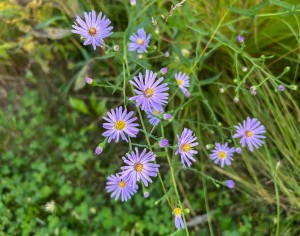
Smooth blue aster (Symphiotrichum laeve) at New Carlisle Library